- Ryan Helmstetler
- November 16, 2026
Sales Leaderboard Examples: 8 Layouts and When to Use Each


The right leaderboard tells every rep, at a glance, what matters this week and whether they are winning at it. The wrong one tells the same three people they are great and everyone else to stop looking.
The difference is rarely the design. It is matching the layout to the goal. Below are eight sales leaderboard examples, organized by what you are trying to change, with what each board shows, when to use it, and what to watch out for.
If you are still deciding which metrics belong on a board at all, start with our guide on how to choose KPIs for your sales leaderboard. This post is about layouts.
What it shows: Today’s count of the activities that start deals: dials, live conversations, emails sent, meetings booked. Each rep’s number sits next to the daily target, ranked from top to bottom, and it resets every morning.
When to use it: SDR and BDR teams, inside sales floors, and any team rolling out a new outbound motion where effort is the thing you need more of right now.
Watch out for: Volume without quality. If you rank on dials alone, you will get dials. Pair the activity column with one conversion column, such as conversations per 100 dials or meetings held, so nobody wins by burning through a list.
A daily reset is the hidden strength of this board. A rep who had a bad Tuesday starts Wednesday at zero with everyone else.
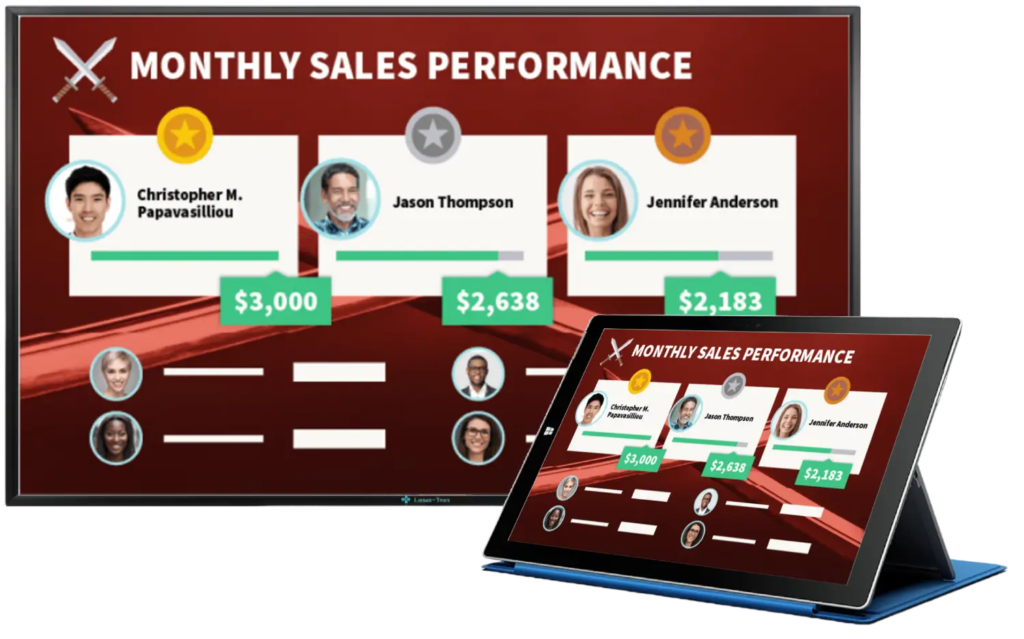
What it shows: New pipeline created this week or month, in dollars or opportunity count, by rep. A second column can show how much of that pipeline has moved past the first stage.
When to use it: Account executives in the first half of a quarter, when the deals that will close in week 12 still need to be created. It is also useful after a slow quarter, when the problem is a thin pipeline rather than poor closing.
Watch out for: Inflated opportunities. If reps get credit for creating opportunities, some will create opportunities that should not exist. Count pipeline only after it reaches a qualified stage, or credit opportunities that survive 14 days without being closed out.
What it shows: Each rep’s closed revenue as a percentage of their own quota, ranked, with a line marking 100%. Raw dollars appear as a secondary number, not the ranking.
When to use it: The second half of a month or quarter, and any team where territories or segments differ in size. Ranking by percent of quota lets a mid-market rep with a smaller number compete fairly with an enterprise rep carrying a bigger one.
Watch out for: The board that never changes. If the same names sit at the top every period, add a second view (see the most improved board below) so the middle of the pack has something to chase.
What it shows: Pods, regions, or offices ranked against each other on one shared metric, such as meetings booked or revenue per rep. Individual names appear inside each team card, but the ranking is by team.
When to use it: When you want reps helping each other instead of competing for the same leads, and for distributed or hybrid teams where one office rarely sees another.
Watch out for: Uneven team sizes. Rank on a per-rep average, not a total, or the biggest team wins by headcount. Also make sure every person on a team can move its number. A team board where one rep carries the score breeds resentment fast.
What it shows: One number for the whole group and progress toward it, often as a progress bar or thermometer, with a running feed of who contributed what. There is no individual ranking at all.
When to use it: End of quarter pushes, mixed teams where roles are not comparable (SDRs, AEs and account managers on one floor), and teams that are tired of ranked competition. It is also a good first board for a team that has never used one.
Watch out for: Free riders. A visible contribution feed solves most of this, because everyone can see who moved the bar today.
What it shows: Only reps in their first 90 days, ranked against their ramp plan rather than against tenured reps. Milestones work well here: first meeting booked, first opportunity created, first deal closed, first week at full activity target.
When to use it: Any team that hires in cohorts or is adding headcount. New hires watching a main board where they sit at the bottom for three months learn the wrong lesson. A ramp board gives them a race they can actually win.
Watch out for: Keeping it private. The point is that the whole team sees new hires hitting milestones. Celebrate the first deal loudly.
What it shows: Each rep’s result this period compared with their own trailing average, ranked by percentage improvement. The top performer and the rep who has been struggling are on equal footing.
When to use it: Alongside a quota or revenue board, never instead of one. It is the best tool for engaging your core performers, the reps between the top and the bottom who make up most of your number.
Watch out for: Sandbagging. If a rep can win by having a bad month first, use a longer baseline, such as the trailing 90 days, and set a minimum activity floor to qualify.
What it shows: Two reps or two teams matched against each other for a fixed window, with a live score and a countdown clock. Brackets let you run a tournament where winners advance round by round.
When to use it: Short bursts of energy: a two-hour power hour, a Friday afternoon, or the last week of a month. Head-to-head matchups also let you pair reps of similar ability, which makes the contest feel winnable for everyone.
Watch out for: Running it constantly. Contest boards work because they are temporary. For more on rotating formats so reps do not tune out, see our post on keeping sales contests fresh.
| Your goal | Start with | Add next |
|---|---|---|
| More conversations and meetings | Daily activity board | Head-to-head contest board |
| Fuller pipeline next quarter | Pipeline builder board | Team vs team board |
| Closing the month or quarter | Quota attainment board | Team goal board |
| Engaging the middle of the pack | Most improved board | Head-to-head (matched pairs) |
| Faster ramp for new hires | New-hire ramp board | Team goal board |
| Collaboration across pods or offices | Team vs team board | Team goal board |
Most teams run two or three boards at once: one steady board tied to the core metric, and one rotating board that changes with the month’s priority.
Our longer guide on how to build a sales leaderboard that motivates instead of discourages goes deeper on fairness, tiers and coaching around the board.
Every example above can run on Hoopla’s live sales leaderboards. Metrics flow in automatically from Salesforce, HubSpot, Microsoft Dynamics, Talkdesk, Google Sheets and more, so the board moves as the work happens. Head-to-head Faceoffs, races and tournaments cover the contest layouts, and Newsflashes put an automatic celebration on every screen when a deal closes or a goal is hit.
Boards broadcast on office TVs with a free plug-and-play device, and on laptops, tablets, and the iOS and Android app for reps who are not in the office.
“Our sales reps are motivated by seeing themselves at the top of the live leaderboards. It’s created real behavior change,” says Henry Lam, Sales Operations Manager at Sunbit.
Leaderboards are one piece of a broader sales gamification software program that also includes contests, recognition and rewards. Most teams go live in 24 hours.
Want to see these layouts running on your own CRM data? Book a demo and we will build your first board with you, or start a free, fully supported 30-day trial.

Read More >

Read More >

Read More >